I find myself thinking a lot about God and the role religion is supposed to play in the world. And I’m not happy. I wish that God would do more to help those who cry out to him for relief from their suffering. I wish that the Church would do a better job at reflecting the love and light of Christ and stop failing the people so miserably. And I wish I were a better follower of Christ myself and could be less selfish and self-serving.
But God is who God is. The Church is who she is. And I am who I am. I will never fully understand God. The Church will always be flawed. And I will continue to struggle with my own demons, sin, and shortcomings until the day I die. Nevertheless, I have found this to be true as well: my faith and relationship with God has filled my heart with a peace that surpasses understanding, with joy I could not produce on my own, with love like no other, and with meaning and purpose in a chaotic world that sometimes seems bent on its own destruction.
There is so much in this world and in myself that I wish were different, and so much more that I would like God to do, but I cannot imagine grappling with life’s challenges without God’s help, guidance, and encouragement. Though I have had to swallow the bitter pill of disillusionment and disappointment with God, religious leaders, and even with myself, my faith keeps evolving and producing hope—only now in more realistic ways.
I now understand better that Jesus did not come to solve all our problems for us, at least not in this life. Rather, he came to show us the way to God and the way to know, love, and serve God in our daily lives, as we struggle along with the rest of humanity with all that is wrong with our troubled world. The more I let go of what I cannot change and what God chooses not to change, and instead focus on God’s priorities of loving God and neighbor, the more God seems to appear. The more I shift my focus from asking God to fix everything to seeking wisdom, ability, and opportunities to grow through my adversity and to serve others instead of myself, the more I truly believe that we flawed human beings can still make a difference. Living by faith and God’s love is both our calling and our opportunity to “not be overcome by evil,” but to “overcome evil with good” (Romans 12:9-21).
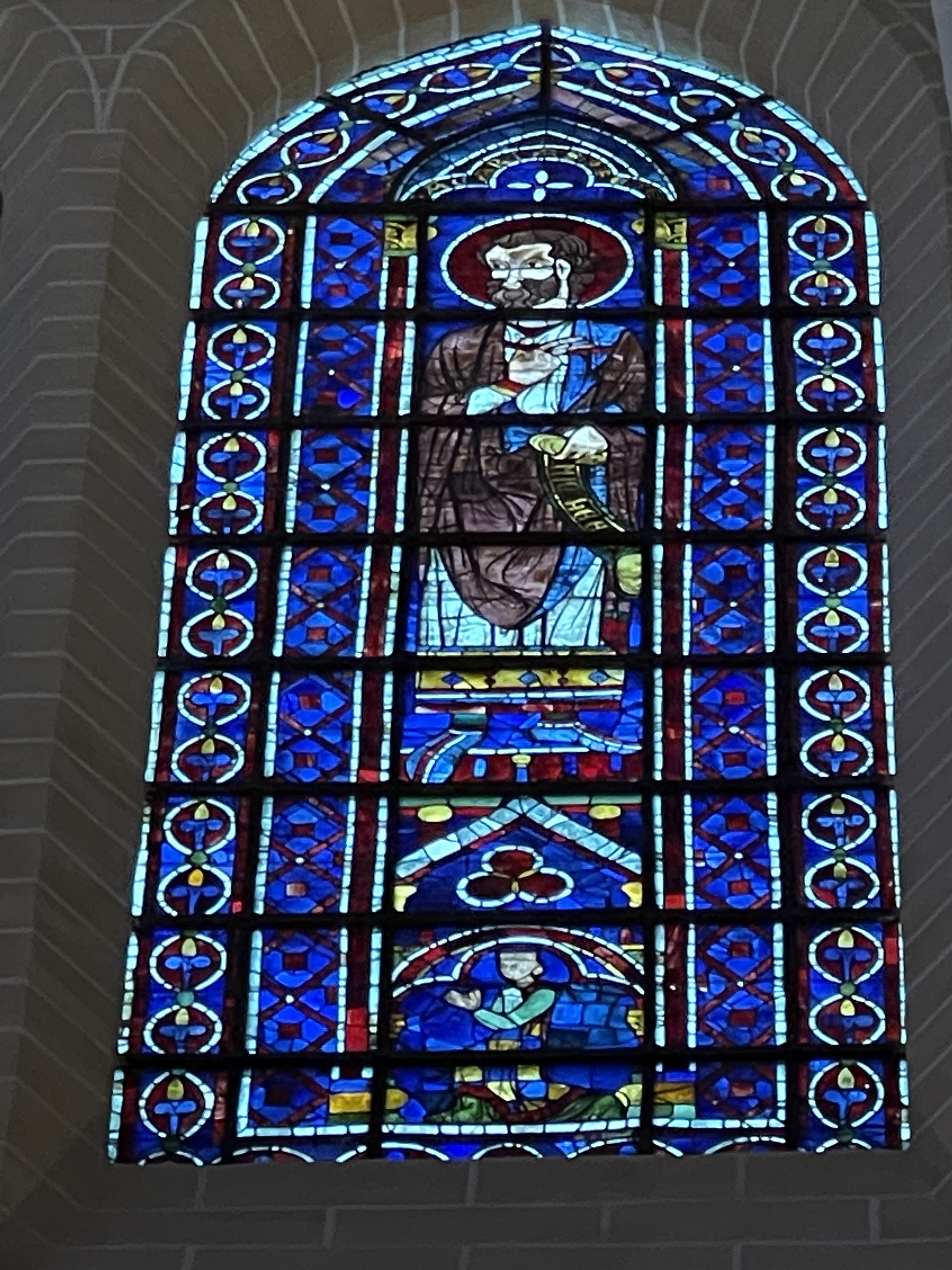
On my 66th birthday this past week, my loving wife, Jill, gave me a special tour of the beautifully restored south transept of the Chartres Cathedral in France. Among the many splendors were stained glass windows depicting many Old Testament prophets and New Testament Apostles, such as Peter and Paul. I was particularly drawn to the window of Micah (pictured above), who summed up God’s requirements for human beings in the familiar command to “do justice, love mercy, and walk humbly with our God” (Micah 6:8). I was also touched by a window portraying two doctors (pictured below), who were being honored for treating the needy for free and sharing the Gospel with those who did not know the way of salvation.
Outside, on the south porch is a tall, striking sculpture of Jesus, le Beau Dieu (the Beautiful God). He’s holding the Book of Life and is surrounded by his disciples, almost all of whom gave their lives to share the Gospel and bear witness to the life, death, and resurrection of Jesus. Underneath him is a much smaller sculpture of a wealthy donor, accompanied by two assistants, who are busy distributing bread to the hungry.
What a perfect combination of images: Prophets and apostles, who teach us about our Creator’s intention for humanity and who show us the way to God. Powerful and privileged members of society, who nonetheless demonstrate their Christian faith by generously serving the needy, at their own expense. Jesus—the way, the truth, and the life (John 14:6)— alongside a faithful follower of Jesus, who shows us what faith looks like when those who are blessed with abundance are surrounded by those who lack the basic necessities for living.
Suddenly the pieces came together for me. It was all there. In the windows and the sculptures, the answer to my broken, anguished heart. Light. Life. Love. Hope. My tears began to flow. Some emotional dam broke. It never felt better to let it all out.
Despite all that is wrong with the world, the Church, and me, and despite all my disillusionment, frustration and disappointment, the message of the Gospel is as relevant today as ever. There are countless individuals who are sacrificially serving others with kindness, compassion, and mercy. The power and presence of God are real. Christ does transform lives. There’s still a way forward for me.
“Lord, thank you for another year and for the precious gifts from your Holy Spirit this morning. Please hold me close to you especially when I begin to doubt and feel so discouraged. Help me to see and accept the life-giving messages of the prophets and apostles. Help me to keep my eyes on Jesus, my heart open to the needs of those around me, and my hands busy serving others. May your will be done more and more.”
After a long 40 years in the wilderness, Joshua led Israel through some tumultuous times, as the people struggled to get settled in the Promised Land. Before he died, in his final speech, he challenged the Israelites to give serious consideration to their faith, values, and commitment. As they prepared to go forward into a new phase of their lives, they needed to decide, whom would they trust and whom they would serve? His speech included these now famous words, as applicable today as they were then:
Now fear the LORD and serve him with all faithfulness… But if serving the LORD seems undesirable to you, then choose for yourselves this day whom you will serve…. But as for me and my household, we will serve the LORD.
Josh. 24:14-15 (emphasis added)
When I (almost) lost my faith in God
One day, in the mid-1990’s, I suddenly realized that I didn’t trust God as much as I once did. I had just experienced ten years of one disillusioning, disappointing, heart-wrenching experience after another. My faith had been shaken. I still worshiped and believed in Christ, but something had shifted inside me. And the changes weren’t all good.
Let me back up to the beginning of the story. Disillusionment with God and ministry began setting in about one year into my first pastorate.
In the mid-1980s, my wife and I served as pastors of a small congregation outside Chicago. During our four years there, we lost one child in a miscarriage, and my roommate from college died at the age of 28. I was working up to 70 hours a week in ministry, but I wasn’t seeing the results I had hoped for. While meaningful ministry was taking place, forces much larger than I were keeping this congregation from becoming the growing, vibrant ministry I had envisioned. I didn’t know why God didn’t seem to be helping more.
Then I got sick. On June 24, 1986, the day after my first son was born, I received frightening news. My doctor called me on the telephone. We had been doing some testing, and now he had the results. He tried to break it to me gently. I had been diagnosed with a fatal skin disease. I had perhaps 10 good years left, he told me.
Hearing this prognosis was like being punched in the stomach. What was going on? God had not blessed our efforts at the church the way I had expected. He didn’t save our daughter from death, and now it looked as though my newborn son was going to be fatherless before he was 10, and my wife a widow.
Then my mother got Alzheimer’s disease, which completely took her mind away. My father was forced to retire early. We watched helplessly as his health declined faster than hers. There was little we could do to help either of them. As it turned out, the stress of caring for her took my father’s life in 1998, long before she eventually died in 2002.
None of this made sense to me. In retrospect, I realized that I had entered into full-time Christian ministry with an implicit contract with God: I thought that if I served faithfully, Lord would take care of me. Now, I don’t know what I thought “take care of” actually meant. Whatever I expected, though, I knew I wasn’t getting it. God had failed my parents, my family, my church, and me, so I thought, and my disappointment had begun to turn to doubt and bitterness.
An unexpected breakthrough
In January 1995, I chose to attend an eight-day spiritual retreat. We worshiped, we prayed, and we did some soul-searching. I was looking for some guidance from God about my future. I was completely surprised by what I received.
The second night I suddenly realized that I didn’t really trust God anymore. There had been too much disappointment and pain, and I blamed God. From my perspective, God had let me down.
I was at a crossroads, and I knew it. I realized that to go forward, I was going to have to decide: was I going to choose to trust God or not? I could no longer serve as a Christian leader and teacher while secretly doubting God’s goodness and activity in my life. I had seen the problem, and now I was going to have to choose: continue to be alienated from God and bitter about my mother’s disease and all the other losses in my life, or choose to trust that God was somehow still active in my life for good in ways that I could not fully understand or discern.
In a moment that felt like the equivalent of scales falling from my eyes, I could suddenly see what I had been blind to. I realized I would never be able to prove that God loved me and cared for me, or that he didn’t. Instead, I needed to make a choice. I was going to walk down one spiritual path or another (disbelief, bitterness, or trust), so which one was I going to put my faith in?
When all this became clear to me, I knew in an instant what I would choose. I was sick of carrying around bitterness in my heart, and I was eager to resolve the cognitive dissonance I had been experiencing. Instead of blaming God for my difficult life experiences, I could trust in the God of Jesus Christ and the writers of the Bible. This God was not a stranger to me, but someone I loved and had come to know in many meaningful ways over the years.
Lessons Learned
This painful, difficult experience taught me some very important lessons, which have served me well ever since.
It was my expectations of God that had failed me, not God. In other words, my false expectations that God would spare me from suffering, sickness, and death set me up for disillusionment and disbelief. According to Scripture, God promises to protect us and care for us in general, but not in every circumstance. We can be grateful for all of God’s provision in life, but we should not think that Christians will be exempted from human suffering.
Trust is a choice in the midst of life’s painful and ambiguous circumstances. We cannot determine whether God is trustworthy strictly on the basis of our experience. There are too many data points when we feel alone, neglected, abandoned, or at the mercy of other forces. No, if we try to add up all the reasons to trust God on one side of the ledger (plusses), and all the reasons not to trust God on the other side (minusses), we will never be able to logically draw a conclusion based on our experience. Instead we must conclude the evidence is inconclusive. Our options are either to abandon faith or “leap to faith,” as Christian philosopher, Soren Kierkegaard, once famously argued.
The late professor and best-selling author on Christian spirituality, Henri Nouwen, wrote about the choices all of us have in the midst of life’s ambiguous circumstances. He said,
Where there is reason for gratitude, there can always be found a reason for bitterness. It is here we are faced with the freedom to make a decision. We can decide to be grateful or to be bitter.
Life of the Beloved. Spiritual Living in a Secular World, p. 61
When we look at our suffering, our losses, all that is wrong with the world, and all the problems and difficulties we must face, we may feel powerless at such times, but we’re not. We have the power to choose our attitude. We can decide to cling to the God we have known and loved, even with so many unanswered questions and hardships. We can look at our circumstances through the eyes of faith. We can choose to be grateful for how we see God at work in our lives, and let the rest go.
Hidden Lake, Glacier National Park, Montana, USA
Spiritual Application
The answer to doubt and disillusionment with God is not ignoring your doubts. It is not pretending as if you do not have questions or pain in your heart. It is not trying to force yourself and others to believe by simply preaching louder and more forcefully.
No, the answer to doubt begins by acknowledging that there are many things you do not understand about God, yourself, and this life–and perhaps never will. Yet, no matter how dark it gets, how lost you may feel, or how much you have suffered; when you reach the end of your ability to reason your way to God, you can still choose to put your trust in your Creator and in Jesus Christ. You can still leap to faith.
And as you do:
You will experience more of the peace the surpasses understanding.
You will be freer to use your energy for constructive purposes.
You will be more gentle and kind to others, and more available emotionally to help and support them.
You will be able to listen better to whatever God wants to say to you in the midst of your uncertainty and suffering.
You will be on your way to experiencing the joy of a Spirit-filled and Spirit-led life.
May our Lord Jesus Christ himself and God our Father, who loved us and by his grace gave us eternal encouragement and good hope, encourage your hearts and strengthen you in every good deed and word.
2 Thess. 2:16-17
Upcoming: A new series of essays on next stepsfor navigating the ongoing global crisis as Spirit-led followers of Christ.
CONTEXT: I CREATED THIS ESSAY SERIES IN RESPONSE TO THE COVID-19 GLOBAL CRISIS. EACH ESSAY EXPANDS ON THE PRACTICAL SUGGESTIONS OFFERED IN THE SPIRIT-LED LEADER: NINE LEADERSHIP PRACTICES AND SOUL PRINCIPLES (HERNDON, VA: ALBAN INSTITUTE, 2005), PAGES 184-90.
Photo Credits:
Photo of man at crossroads courtesy of Vladislav Babienko
Photos by Timothy Charles Geoffrion (www.thiswalkinglife.com): highway in Wyoming desert; sunrise at Grand Staircase, Escalante National Monument, Utah; and Crown Jewel of the Continent, in Glacier National Park, Montana. Thank you!
Help us spread the good word! Please share these essays with as many people as possible. If you have been personally touched or encouraged by one or more of these essays, please help spread the word by supporting our efforts to translate and distribute them around the world bymaking a donation to Faith, Hope, and Love Global Ministries, today.





 The Spirit-Led Leader