Are you tired of feeling angry, sad, or hopeless so much of the time? I sure am.
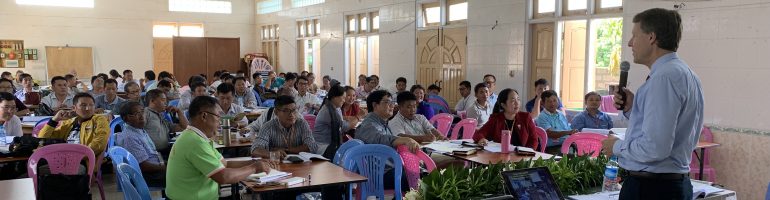
When I returned from Thailand in June, I came home very tired. I was grateful for all the opportunities I had had to teach and minister to refugees and church leaders along the Myanmar-Thai border, but I felt stressed and worn out. The needs were great, and I felt my limitations keenly. Then, as I saw with horror what was happening in my own country, as well as in many other places around the world, my distress began multiplying. My peace and joy dissipated. I was angry most of the time, and I increasingly felt like I was fighting a losing battle.
For my own sanity and well-being, I needed to do something different. But what?
Over the next couple months, I’m going to be writing about some of what I’ve been learning about coping with overwhelming distress. Starting with this post, I’m going to be sharing three strategies that have been helpful to me personally. I hope that they will also be useful to you as well.
Strategy #1: Be self-compassionate. Take loving care of yourself and look to God to refresh your heart and mind.
The Psalmist (King David) tells us that in his times of distress he found what he needed in his relationship with God, whom he knew as his loving shepherd. In the now famous Psalm 23, the first few verses go like this:
“The LORD is my shepherd, I lack nothing. He makes me lie down in green pastures, he leads me beside quiet waters, he refreshes my soul” (Psalm 23:1-3a, NIV).
David didn’t criticize himself for feeling afraid, overwhelmed, or discouraged by his circumstances. He also didn’t try to tough it out or shame himself for needing comfort or help from God. No, in his distress, David acknowledged his needs and reached out to his Shepherd for the restoration and refreshment he could not provide for himself in the same way.
As I prayed for wisdom to know what would help me in my distress this summer, the answer came fairly quickly. Contrary to the voices that sometimes creep into my head, the answer was not to “suck it up,” chastising myself for being weak. Shaming myself for complaining when the IDPs (internally displaced people) and refugees have it so much worse than I would only drain me of whatever energy I still had. Pushing harder and trying to do more was not going to help either. That would only burn me out.
Instead, what I most needed was to be kind to myself. I needed to see how very distressed and troubled I was feeling, and to respond to myself with compassion. Just as I have often tried to be gracious and generous to others amid their suffering, it was time for me to show the same empathy and consideration toward myself. And the result has been transformative.
Slowing my pace and resting more has been healing. Playing sports has been fun, and working out regularly has made me feel better physically and emotionally. Walking in the forest, boating on the lake, or just being out in nature as much as possible has been nourishing and literally a breath of fresh air. Enjoying time with family and friends has satisfied my cravings for love and affection. And getting alone to think, write in my journal, pray, read the Bible, or just sit and listen to music has been so helpful. I need to stay grounded to (re)gain and maintain perspective. It’s how I stay connected to my Shepherd as well as to myself.
By tending to my needs in these ways, I wasn’t giving up on those I cared about and have been called to serve. Not at all. I have been exercising self-compassion. I’ve been treating myself kindly and tapping into the many resources God has provided for my nourishment, enjoyment, and renewal—both for my sake and for the sake of all those God has entrusted into my care.
How about you? How are you coping with your anger, weariness, and anguish these days?
When you take care of yourself in the ways God intends for you, it’s not self-indulgence, self-pity, or self-centeredness. It’s self-compassion, which flows from the very heart of your loving Shepherd, who sees you in your distress and wants to make you lie down in green pastures and lead you beside still, restorative waters. The Lord doesn’t only care about what you do for others. He also cares about you and wants you to believe that you, too, are worthy of kindness and compassion.
Spiritual Truth 7: Expect to be renewed, as you accept your limitations and wait on God.
In the waking dream that I wrote about in my last essay, I saw a huge wall of water that looked as if it were going to break at any moment and wash me away. I could see all my anxieties spread out on a blanket on the ground in front me. I wanted to fold the blanket around them, as I usually do, to lift them up into God’s hands. But I couldn’t. It was too heavy! When I looked more closely, I realized that there was a huge boulder in the middle of the blanket. How was I going to lift that up?
At first, I didn’t know what to do. Then, for some reason, I began to slowly approach the big rock. I cautiously put my hand on it, and much to my surprise, it began to shrink. It turns out that it was actually an earth-filled piece of ice, which began to melt with my touch. The smaller it became, I the lighter I felt.
Afterward, I realized what the dream meant. When our anxieties feel too heavy to lift to God, we may need to face our worries head on first. Instead of just reacting to them, denying them, running away from them, or simply being a prisoner to them, we can gather our courage and approach them directly. As we name (“touch”) them, we are likely to learn something about them and ourselves that will set us free from their power. They may turn out to not be as big or threatening as we thought, or we may gain insight as to how to handle them better. Or else, we may simply let them go.
The combination, then, of consciously addressing the nature of our worries and trusting God to act is freeing and renewing.
Spiritual Truth 7: Expect to be renewed, as you accept your limitations and wait on God. (Heb. 2:15; Isaiah 40:28-31; Eph. 3:20-21)
In one of the most often-quoted chapters of the Bible, Isaiah 40 offers words of comfort to the people of Israel, who were languishing in captivity in Babylon. They could do nothing to change their circumstances. They were stressed, afraid, and felt a huge weight of guilt. They were suffering the consequences of their sin and poor choices. So, Isaiah writes these now famous words:
Have you not known? Have you not heard?
The LORD is the everlasting God, the Creator of the ends of the earth.
He does not faint or grow weary; his understanding is unsearchable.
He gives power to the faint, and strengthens the powerless.
Even youths will faint and be weary, and the young will fall exhausted;
but those who wait for the LORD shall renew their strength,
they shall mount up with wings like eagles,
they shall run and not be weary, they shall walk and not faint.
Isa. 40:28-31, NRSV
There is so much hope and encouragement in these words. You and I get weary and exhausted. Yahweh (the LORD) never tires and his strength is inexhaustible. As we hit the wall or sag under the weight of our worries, we must look beyond ourselves to the Creator of the universe. The everlasting God is the one who can lift our heavy burdens and renew our spirits.
We must “wait for the LORD (Yahweh)” by admitting our limitations and human frailty and by putting our hope in what only God can do. And when we do, we will often feel lighter. We will find that we can open up our hearts and minds to the Spirit again. We will become refreshed and more energized. We will be better able to fulfill our purpose in life, to know, love, and serve God. In Isaiah’s imagery, we will “mount up with wings like eagles.” We will “run and not be weary.”
Let anxiety be your teacher
Anxiety is a normal part of human experience that often feels stressful and burdensome. However, if we let anxiety be our teacher, it can reveal something about our situation and our fears that could be helpful.
For example, when we feel anxious, it often means that something important is at stake. We, or someone or something we care deeply about, are threatened. If we stay in the anxious thoughts and feelings, we’ll be miserable. But if we let our anxiety guide us to a deeper understanding of our own values and needs, we may gain new insight into what’s going on and if, what, and when we can do something about it.
Practically, I have found it very helpful to divide my anxieties into one of three categories. First, I have to face and name them. Then, I need to first decide for each one, is there something I can do about this concern? Depending on my answer, I put it into one of three categories: Act, Wait, or Let Go.
Category 1: Act.
If there seems to be something I can do, the worry goes in Category One: Act. For example, when COVID-19 started spreading everywhere in the USA, I worried about whether or not my family and I were going to get sick or even die. I immediately realized that, while I could not control the spread of the virus, we could try to protect ourselves. As soon as we took action to do what was within our power to do (e.g., to wear masks, wash our hands regularly, socially distance ourselves from others, avoid crowded places, etc.), our anxiety levels started going down. The danger didn’t go away, but our anxiety lessened because we were doing something to help ourselves.
Category 2: Wait.
If the worry is something that I can’t do anything about now, because I’m waiting on information or someone else’s actions, then it goes into Category 2: Wait. For example, will I be able to conduct my scheduled workshops in Myanmar and Vietnam this fall? Will I be able to teach again at Myanmar Institute of Theology (MIT) second semester? When will it be safe enough for me to travel internationally?
I can’t know the answer to these questions now. I have to wait to see what the Myanmar government decides, whether the virus can be contained, and what kind of safeguards can be put in place. For now, instead of worrying about what I think the authorities should do or about what I’m going to be able to do, I need to tell myself, the time is coming when I will know the answers. Until then, I need to wait. I need to turn my attention to what I can do something about (Category 1) and to wait to see what God is going to do.
Category 3: Let go.
Finally, many times, the thing I am anxious about is completely out of my control, and there is nothing I can do. For example, I’m wondering, are my students and colleagues in Myanmar and my other global partners going to be O.K? Will there be an economic depression? Will the world ever fully recover from the pandemic? These kinds of issues are ongoing. They will probably remain as a threat indefinitely. Waiting for answers could go on forever. So, I tell myself, I will cross that bridge when I get to it. Until then, if there’s nothing I can do, I’m going to let it go. It’s O.K. I don’t need to hang on to a worry that I can’t do anything about.
Church of the Holy Sepulchre (Old city of Jerusalem, Israel)
Spiritual Application
How heavy is your load these days?
If you can gather your worries together and put them in God’s hands, do it! But if the weight seems too much, or your circumstances too overwhelming, try this: Muster your courage and move toward your anxieties. Name (touch) each one, and ask it, “What do you want me to know about you? What can you tell me that might help me to cope better?”
Is there something, anything, you could do to help alleviate your worries? If so, it is time to Act. Do what is within your power to help yourself. If, on the hand, there’s nothing for you to do now, then, tell yourself to Wait. Wait for the time when action is possible again and focus your attention on better things in the meantime. Finally, if the worry is completely outside of your control or the dangers are ongoing, then Let go.
The more you face your own human limitations and accept that you are only responsible for what is within your power to do, the freer you will become. You will stop trying to carry burdens that are not meant for you to carry. You will rest more peacefully in the Father’s immense love. You will spend your days living fully, being creative, and sharing Christ’s love and light with all those you most care about.
In your own strength, you are going to reach your limits. That’s why you get weary and exhausted. So, stop trying to lift what is too heavy for you, and stop worrying about things that may never happen. Put your burden into God’s hands and wait for him to act in his way and timing. Stop worrying so much about what you cannot control or do, and let the Holy Spirit renew your heart, soul, and mind. The old cliché, “let go and let God,” is actually quite biblical…and helpful. It’s also the way to greater peace and joy.
Now to him who by the power at work within us
is able to accomplish abundantly far more than all we can ask or imagine,
to him be glory in the church
and in Christ Jesus to all generations, forever and ever. Amen.
Eph. 3:20-21
Next week: In the conclusion to this essay series, I will be sharing my personal story of how I learned to trust God again after personal tragedy.
Help us spread the good word! To reach more people who need biblical and practical words of encouragement in the midst of the COVID-19, global crisis, we are translating these essays into 10 different languages spoken in various parts of Myanmar, India, and the Democratic Republic of Congo (DRC). If you have been touched or encouraged by one or more of these essays, please help spread the word by sharing it with others, andbysupporting our efforts to reach more people bymaking a donation to Faith, Hope, and Love Global Ministries, today.
CONTEXT: I CREATED THIS ESSAY SERIES IN RESPONSE TO THE COVID-19 GLOBAL CRISIS. EACH ESSAY EXPANDS ON THE PRACTICAL SUGGESTIONS OFFERED IN THE SPIRIT-LED LEADER: NINE LEADERSHIP PRACTICES AND SOUL PRINCIPLES (HERNDON, VA: ALBAN INSTITUTE, 2005), PAGES 184-90.





 The Spirit-Led Leader